






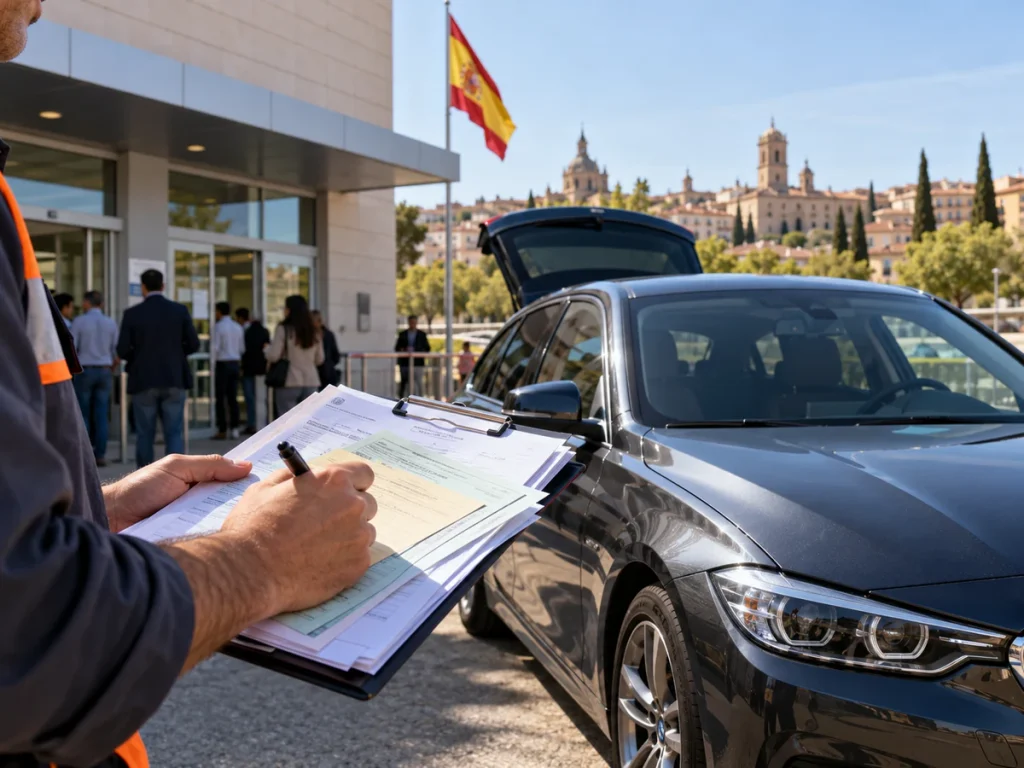
If you have bought a car in another European country and want to use it in Spain, the vehicle will generally need Spanish registration before it can circulate normally on Spanish roads. The process involves checking ownership documents, establishing the car’s technical details, dealing with taxes and applying to the Dirección General de Tráfico (DGT).
The steps below focus on a vehicle acquired in another EU country. Imports from outside the EU can involve customs clearance and a different, more complex technical approval process.
Step 1: Keep the original documents from the country of purchase
Before transporting the car, obtain its original registration papers and proof of acquisition. If you bought from a private seller, keep the signed purchase contract. If a business sold the vehicle, request a proper invoice with the relevant seller details.
Spanish authorities may require different tax or supporting documents depending on whether the seller is a private individual, a foreign dealer or a Spanish dealer. Keep any export or deregistration paperwork and confirm the arrangements with the country where the car was previously registered.
The European Certificate of Conformity (COC) is particularly helpful because it identifies the manufacturer’s type-approval information and technical configuration. If the original is missing, investigate the required evidence before scheduling the next step.
Step 2: Obtain the Spanish ITV technical card
A car imported from another EU country normally needs to attend an authorised Inspección Técnica de Vehículos (ITV) station to obtain a Spanish technical card, known as the ficha técnica española.
The DGT explains that technical approval may be demonstrated through a European COC, a ficha reducida or, in certain cases, an individual approval document. Which route is acceptable depends on the vehicle’s age, approval and characteristics.
Bring the foreign registration papers, the appropriate conformity or technical document and the purchase document where applicable. The station will check the vehicle and, if everything is in order, issue the Spanish ITV documentation required for registration.
Step 3: Review taxes before applying to the DGT
Spanish registration usually requires evidence concerning both the national registration tax and the municipal road tax.
The Impuesto Especial sobre Determinados Medios de Transporte (IEDMT), often referred to as registration tax, may be paid, exempt or not applicable depending on the circumstances. The relevant declarations commonly involve tax forms such as Modelo 576, 05 or 06, according to the case.
You may also need proof of payment or exemption of the local Impuesto sobre Vehículos de Tracción Mecánica (IVTM). For a used vehicle purchased privately, property-transfer tax (ITP) can also matter; for a new vehicle bought within the EU, VAT treatment requires special attention.
Exemptions, including some cases involving a change of residence, are subject to specific conditions. Do not assume that an imported vehicle is automatically tax-free.
Step 4: Submit the Spanish registration application
Once the technical and tax documents are ready, apply through the appropriate DGT procedure. The supporting file normally covers identification, proof of ownership, the original foreign documents, Spanish ITV card and the relevant tax evidence.
If the application is accepted, the DGT assigns a Spanish registration number and issues the permiso de circulación. You can then obtain the corresponding number plates from an authorised supplier.
Make sure the vehicle has valid compulsory motor insurance before using it on public roads.
Can you drive while the Spanish registration is pending?
Not automatically. The DGT describes a temporary registration route, commonly involving green temporary plates, for eligible vehicles while permanent registration is processed. Valid temporary foreign plates may be usable under applicable conditions, provided the insurance and authorisation remain valid.
Do not rely on foreign plates or insurance solely because the vehicle has recently arrived in Spain. Check the lawful transport and temporary-use arrangements for your specific case.
What changes if the car comes from outside the EU?
A vehicle imported from a non-EU country can require customs clearance, import documentation and additional technical approval steps. A manufacturer COC may not exist if the vehicle was built for a market outside the European approval framework.
Before purchasing a non-EU-market car, ask about its registration eligibility. Modifications required for lighting, emissions or other technical conditions can materially increase the cost of importation.
A practical checklist before your ITV appointment
Check that the registration papers are complete; obtain a contract or invoice; confirm the required COC or alternative technical evidence; establish the likely tax position; and verify whether the vehicle needs changes before inspection.
If your car is eligible and the original certificate is missing, you can browse the COC Market Shop for manufacturer-issued conformity-document options.
Final tip: use the DGT’s current official guidance as the final authority. The correct paperwork and tax treatment depend on whether the car is new, used, previously yours, EU-origin or non-EU-origin.
Official sources and further reading
Information reviewed October 2026. Regulations, authority procedures and document acceptance can change; confirm the latest local requirements before applying.