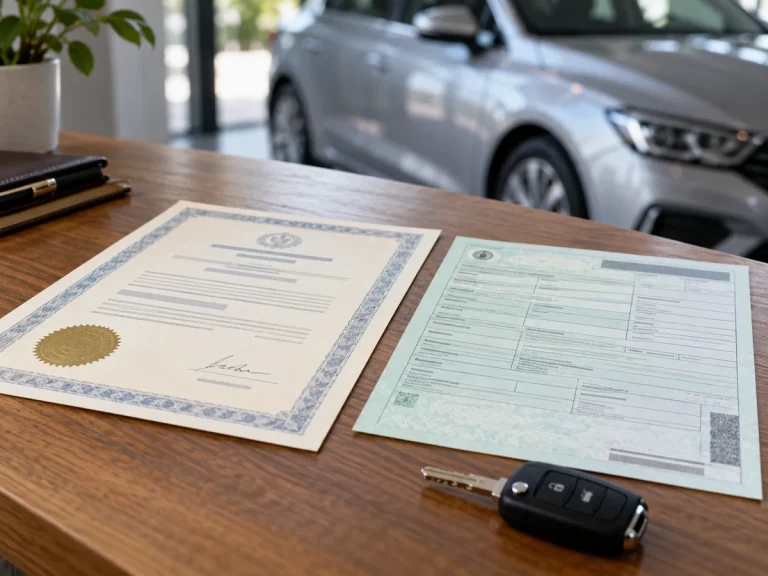








A Certificate of Conformity (COC) is one of the most useful technical documents when a vehicle is registered in a European country. Yet many drivers only hear about it after buying a car abroad or receiving a request for additional paperwork from a registration office.
The good news is that the document has a specific purpose. Understanding what it proves—and what it does not prove—can make the process of registering an imported car far easier to navigate.
What exactly is a vehicle Certificate of Conformity?
A vehicle COC is a declaration issued by the manufacturer confirming that an individual vehicle corresponds to an approved vehicle type. In the European system, it records the technical characteristics associated with the vehicle’s type approval and its configuration when manufactured.
In practical terms, a COC helps an authority identify the approved version of a vehicle without asking the owner to reconstruct its technical specifications from scratch. It is not an ownership certificate, an insurance document or a vehicle inspection report.
An EU Certificate of Conformity should also not be confused with general CE-marking declarations used for consumer products. Although the wording is similar, the applicable rules and documentation are different.
What information can a COC contain?
The exact fields depend on the vehicle category and applicable approval rules. A passenger-car COC commonly includes information such as:
- Manufacturer, commercial designation, type, variant and version.
- Vehicle identification and EU type-approval details.
- Engine or powertrain specifications and fuel or energy type.
- Dimensions, masses and permitted seating capacity.
- Approved tyre and wheel specifications.
- Emissions, noise and other regulated technical characteristics.
For motorcycles, commercial vehicles and multi-stage manufactured motorhomes, the fields and approval arrangements can differ. What matters is that the document relates to the specific vehicle, not merely to a model name.
When might you need a Certificate of Conformity?
A common situation is registering a vehicle bought in another EU country. An owner may purchase a car in Germany, move it to Spain or France, and need to provide technical conformity evidence as part of the registration application.
A COC may also be useful when the original document has been lost, when technical data are missing from the existing registration papers or when a registration authority asks for manufacturer-related information.
However, a COC is not automatically necessary in every case. Some registration authorities can obtain technical information through their own systems or accept specified alternative documents. Requirements depend on the destination country and the vehicle’s history.
Does a COC guarantee that the car can be registered?
No. A valid COC supports identification and technical conformity, but it does not settle every part of a registration application. You may still need to provide the previous registration certificate, proof of ownership, evidence of tax treatment, insurance and a roadworthiness inspection.
Vehicles that have been substantially modified, individually approved or manufactured for markets outside the European type-approval system may need additional technical assessment. An original COC reflects the approved vehicle configuration, not necessarily every modification made later.
What happens if the original COC is missing?
Start by checking the documents supplied when the vehicle was originally sold. Sometimes the certificate is stored separately from the registration papers. If it cannot be found, an eligible vehicle may be able to obtain a manufacturer-issued duplicate through an authorised channel.
Before making a request, verify that the vehicle is eligible and determine whether your registration authority requires a paper document, accepts a digital certificate or permits another form of conformity evidence.
For example, Spain may accept a ficha reducida for certain procedures, while France and Germany have their own rules for technical conformity documentation. A replacement COC is therefore one possible route, not the only route in every situation.
How COC Market can help
COC Market offers a dedicated catalogue for passenger cars, motorcycles, trucks, vans, campers and motorhomes. You can browse the available manufacturers and review the document options for your vehicle before ordering.
If you are preparing a cross-border registration, begin with the documents required by the destination authority. Then explore the COC Market Shop to find the relevant manufacturer and request the appropriate certificate.
The key takeaway: a COC establishes approved technical characteristics; the registration authority decides whether the full registration application meets local requirements.
Official sources and further reading
Information reviewed October 2026. Regulations, authority procedures and document acceptance can change; confirm the latest local requirements before applying.